
This year's Economic Survey and the Union Budget were more closely followed for more reasons than one.

Shares of Indian life insurance companies, particularly SBI Life Insurance and Canara HSBC Life Insurance, saw significant declines after the Department of Financial Services (DFS) secretary, M Nagaraju, stated that banks are being asked to avoid exclusive tie-ups with their own insurance subsidiaries and instead remain neutral.

It said that the GDP growth has averaged 7.3 per cent from 2014-15 to 2017-18, which is the highest among the major economies of the world.

CAD touched a historic high of $88 billion in 2012-13.
Inflation is expected to moderate to 6.5-7 per cent by March end but spiralling global crude oil prices pose a challenge in the coming months, said the Economic Survey 2011-12.

The Trinamool Congress has launched a sharp attack on the Narendra Modi government over rising fuel prices, economic concerns, and exam irregularities, accusing the Centre of betraying citizens.

India has become the fourth largest economy in the world due to a strong economic growth but still has a low per capita income, the Economic Survey revealed.

India is the second-most-preferred destination among chief executive officers planning international investments - up from the fifth spot last year, according to PwC's 29th Annual Global CEO Survey released on Tuesday. The United States is their first choice.

'It will take a long time to recover from the impact of this war.'

During 2013-14, imports from Japan, South Korea and Malaysia stood at $9.49 billion, $12.47 billion and $9.21 billion respectively.

The NSO previously tried to collect household income data in its ninth (1955), 15th (1959), 19th (1964), and 24th (1969) rounds (July 1969-June 1970), but these efforts were not completed, partly due to non-responsiveness by respondents.

India's demographic advantage and diverse economic landscape position it uniquely to benefit from AI, the Economic Survey for 2024-25 tabled in the Parliament on Friday afternoon asserted. However, achieving these benefits requires significant investments in education and workforce skilling, supported by enabling, insuring, and stewarding institutions, the state of the economy report tabled by Finance Minister Nirmala Sitharaman said.

Over the past year, the sale of injectable GLP-1 agonists (used to treat type 2 diabetes and obesity) such as Mounjaro, Wegovy and Ozempic have surged a whopping 218 per cent.

A higher level of private sector financing and resource mobilisation from new sources will be crucial for India to build quality infrastructure, according to the Economic Survey 2023-24. The Economic Survey 2023-24 was tabled in Parliament by Finance Minister Nirmala Sitharaman on Monday.

India's unemployment rate reached an 11-month high of 5.5 per cent in May, up from 5.2 per cent in April, according to the National Statistics Office, indicating a softening labour market as labour-force participation also eased.

For the foreseeable future, the most likely outcome remains continuation of the status quo. Taiwan will remain self-governing without formally declaring independence, while China continues to apply sustained pressure short of war, predict Krishnan Srinivasan and Manoj Mohanka.

Dr Lovi Raj Gupta, pro vice-chancellor, Lovely Professional University, explains how aspiring professionals can equip themselves for a competitive AI-driven job market.

Chinese manufacturing prowess and its dominance in the strategic sector will have a bearing on India's growth projection in the medium term and its march to become a developed nation by 2047, the Economic Survey said on Friday. The Survey has said India needs to grow at 8 per cent for about two decades to become a developed nation by 2047, but it will have to face challenges from global developments and reliance on Chinese imports.

Some might contend that a candidate for being termed the most corrupt (or corrupting) country in the world is Switzerland.

A caste survey conducted in Telangana reveals that certain communities, such as Iyengers/Iyers, report the highest rates of inter-caste marriages, indicating a weakening of social barriers and increased social mobility.

The boundary mess between India and Nepal needs a solution in a manner as mentioned by Nepal's Foreign Minister Shishir Khanal: 'On evidence not emotions', counsels Lieutenant General Shakti Gurung (retd).

The Reserve Bank's growth projection for next financial year is lower than 8-8.5 per cent projected by the finance ministry in the recent Economic Survey which was tabled in Parliament on January 31. Unveiling the bi-monthly policy, RBI governor Shaktikanta Das said, "Recovery in domestic economic activity is yet to be broad-based, as private consumption and contact-intensive services remain below pre-pandemic levels."

Amid a debate over 70-90-hour work week, the pre-Budget Economic Survey on Friday cited studies to state that spending over 60 hours a week on work could have adverse health effects. The survey noted that spending long hours at one's desk is detrimental to mental well-being and individuals who spend 12 or more hours (per day) at a desk have distressed or struggling levels of mental well-being.
As India marks a decade of the Goods and Services Tax (GST), the focus is shifting towards enhancing efficiency through artificial intelligence, data sharing, and process simplification. The reform, which unified India's indirect tax system, has significantly broadened the tax base and boosted revenues, with future plans including a streamlined two-tier rate structure and continued technological integration to reduce compliance costs and combat evasion.

The BJP team under the new national president Nitin Nabin, who took charge in January, is expected to be announced within this month, with sources suggesting that some holding positions in the government may move to the party.

A joint study by IBM and IndiaAI, a MeiTY initiative, indicates that Artificial Intelligence (AI) has the potential to contribute over USD 500 billion to India's economy by 2030. The report highlights the need for improved AI literacy, infrastructure, and data quality to fully realise this potential.

The Congress party has strongly criticized the Union Budget, calling it 'lacklustre' and 'disappointing,' claiming it fails to address the needs of farmers, unemployed youth, and other key sectors.

Finance Minister Nirmala Sitharaman will present the general budget in Parliament on February 1. The Budget session of Parliament begins on January 28 with President Droupadi Murmu addressing both houses.

The Survey projected growth rate of 7-7.75 per cent for 2016-17 with downside risks due to weak global economic scenario.
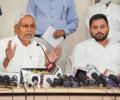
Bihar Chief Minister Nitish Kumar on Wednesday said his government will undertake a "socio-economic survey of all castes and communities" in the state, following the Centre's reluctance to conduct a caste census nationally.

Prime Minister Narendra Modi on Sunday used two major public engagements in Kolkata to outline a broader vision for India's future -- one rooted in inner balance and collective well-being through yoga, and the other in national self-reliance and maritime strength.

Under the TMC, Bengal has seen expansion of welfare, but not big-ticket private investment.

'Once the numbers come out, they fear that the OBCs would start to demand, and articulate what they are lacking, why they are lacking and what should be done to go forward.'

2015 is going to witness new agreements on climate change.

Two of the three strikes are related to the gig economy, a centrepiece of the new labour Codes.

The short-term inflation outlook for India is benign, and the expectation of a normal monsoon and moderating global prices of key imported items give credence to the projections made by the RBI and IMF, the Economic Survey said on Monday. However, to ensure long-term policy stability, the Survey 2023-24 suggested making focused efforts to increase the production of major oilseeds, expanding the area under pulses, and assess the progress in developing modern storage facilities for specific crops.

Insights from behavioural economics suggest that an ambitious nudge can be effective if three conditions are met, points out Ram Singh Insights from behavioural economics suggest that an ambitious nudge can be effective if three conditions are met, points out Ram Singh, director, Delhi School of Economics.
India's economy is projected to grow between 6.3 per cent and 6.8 per cent in FY26, according to the Economic Survey 2024-25, tabled in Parliament on Friday. The survey highlights that the country's economic fundamentals remain strong, supported by a stable external account, fiscal consolidation, and private consumption. It noted that the government plans to strengthen long-term industrial growth by focusing on research and development (R&D), micro, small, and medium enterprises (MSMEs), and capital goods.

A report indicates that mid-tier banking, financial services, and insurance (BFSI) entities in India are highly exposed to cyberattacks due to aggressive digitisation coupled with insufficient cybersecurity investments.
